
THIS PROJECT IS UNDER CONSTRUCTION
EF / World Journeys
THIS PROJECT IS UNDER CONSTRUCTION
When operating at scale, tiny design changes mean massive impact.
CLIENT
EF / World Journeys
TEAM
EF / World Journeys Engineering Team
ROLE
Product Design
UX/UI Design
Art Direction
Brand Strategy
EF / World Journeys is comprised of three B2C guided travel brands—Go Ahead Tours, Ultimate Break, and Adventures. This portfolio represents a billion-dollar travel juggernaut that prioritizes customer experience and a loyal traveler base just as much as growth and conversion (hard to believe, but it’s true).
I was part of several different lanes while on this team—spanning CX, Mobile App, and Web/Acquisition & Conversion. These projects represent some of that work, though I’m sure I’ve got more in my pocket if there’s something specific you’re looking for.
Closing the Loop: Designing a Full-Circle Travel Booking Experience in Mobile
CATEGORY
Native Mobile App
E-Commerce
ROLE
Product Design
My role
For the post-consolidation relaunch, I was the sole designer on the initiative.
I worked alongside product managers and engineers to:
Conduct a cross-platform purchase experience audit
Design the Saved Quotes feature
Design the Notifications experience
Improve accessibility of the tour date picker
Align purchase flows across three brands
Perform end-to-end QA before launch
Design and implementation of these features occurred over approximately two months.
The challenge
Reintroducing mobile commerce after consolidation introduced several complex problems.
1. Stakeholder skepticism about mobile commerce
Some stakeholders felt mobile web already solved the mobile purchasing problem, making native app investment unnecessary.
However:
App usage was extremely high among travelers.
Mobile web analytics were historically unreliable.
The app provided a stronger foundation for personalization and repeat engagement.
This initiative required demonstrating that mobile browsing and discovery could meaningfully support future bookings.
2. Platform consolidation constraints
Following consolidation, the mobile app supported three travel brands on shared infrastructure.
Each brand had subtle differences in:
tour configurations
purchasing options
add-ons
Too much brand-specific customization would undermine the purpose of consolidation.
We therefore had to carefully determine:
what elements could remain shared across brands
where localized differences were unavoidable
3. Cross-platform purchase inconsistencies
PMs requested a full audit of the browsing and purchase experience across:
Desktop web
Mobile web
Mobile app
Although the browsing UX was inherited from web, the mobile app UI relied on native components rather than the web design system.
The design system itself existed only on web, meaning engineers implemented mobile components incrementally using shared tokens.
This resulted in subtle inconsistencies that needed evaluation.
4. Accessibility for an older traveler demographic
The Go Ahead Tours core traveler demographic averages 55–65 years old.
In shadowing sessions, we observed many users relying on extremely large accessibility text sizes, which caused several screens to break.
We used this initiative as an opportunity to improve accessibility in key purchase steps.
Overview
EF World Journeys’ mobile app was historically designed to support travelers before and during trips, not during the discovery and purchase phase. Yet 95% of booked travelers already used the mobile app, presenting a major opportunity to drive repeat bookings directly within the app.
An earlier attempt to introduce in-app shopping existed briefly for one brand, but it was removed during a major platform consolidation initiative. After consolidation, the organization needed to rebuild this capability across three brands.
I became the sole product designer responsible for relaunching the experience, enabling mobile browsing and purchasing for:
Go Ahead Tours
Ultimate Break
Adventures
The work involved aligning mobile and web purchase flows, introducing new engagement surfaces, and ensuring the experience remained accessible for an older traveler demographic (Go Ahead customers).
The design work
1. Saved Quotes
One of the most significant features I designed was the Saved Quotes experience, which allows travelers to pause the booking process and return later.
Users often spend significant time comparing tours and configurations before committing to a purchase. The feature allowed them to save their progress and return directly to the point where they left off.
Quotes could save:
departure dates
number of travelers
flight selections
tour configurations
add-ons such as excursions or insurance
The system captured progress from the moment a traveler selected a departure date all the way through the checkout process.
When a traveler returned to the app, the quote would reopen at the exact point where they had previously stopped.
Analytics later showed that users interacting with saved quotes had strong conversion behavior, with roughly 33% eventually completing a purchase after opening a saved quote.
2. Navigation for Discovery and Re-engagement
Before consolidation, the mobile app navigation focused primarily on trip management:
Chat
Tours
Notifications
Favorites
More
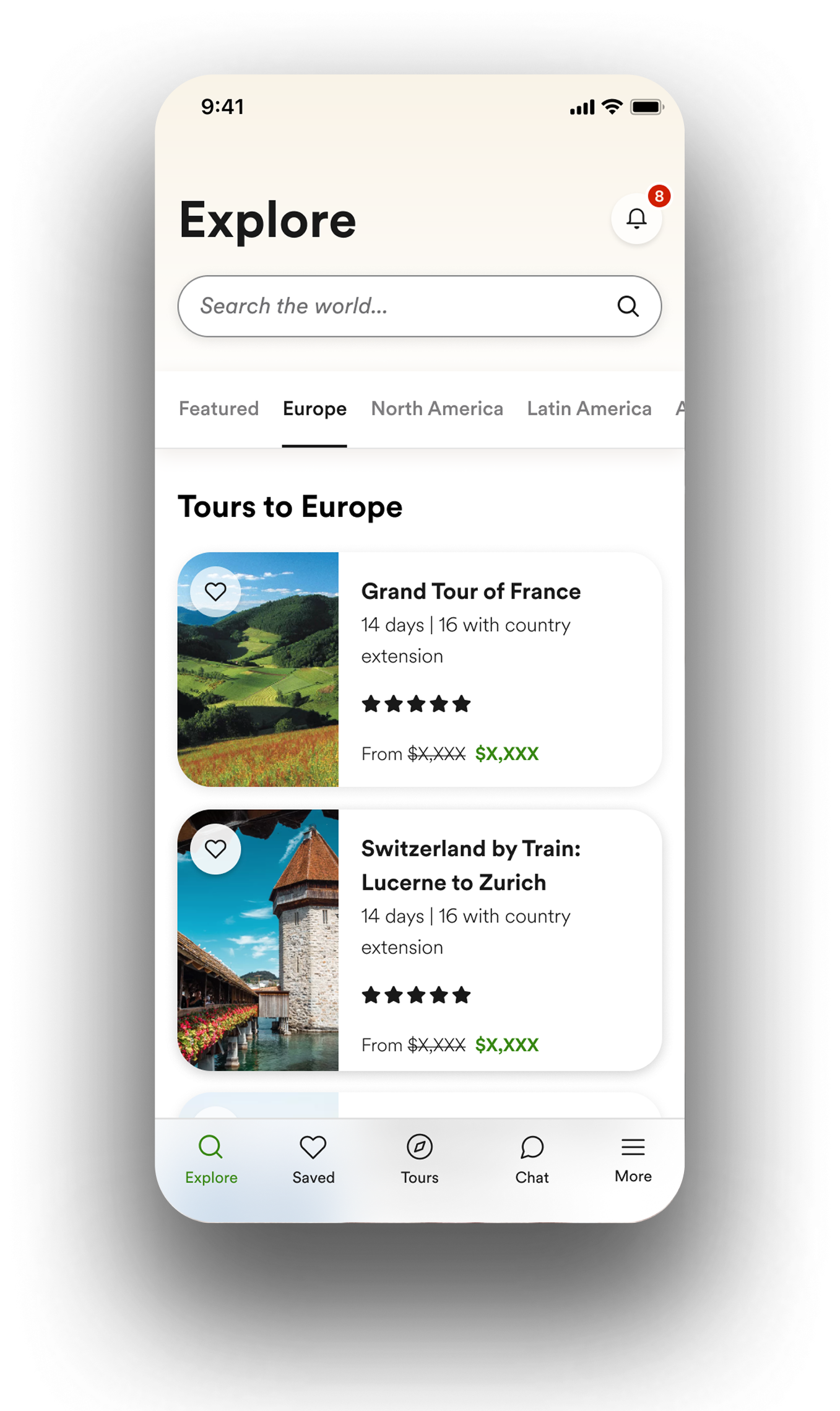
To support in-app shopping, I proposed a new structure centered around discovery and re-engagement:
Explore
Saved
Tours
Chat
More
Key changes included:
Explore
Primary entry point for browsing tours
Saved
Unified location for saved tours and saved quotes
Notifications
Moved from primary navigation into a contextual icon in the screen header
This structure prioritized the early phases of the traveler journey — discovery and consideration — rather than only post-booking functionality.
3. Notifications Experience
I also designed the new notifications interface within the app.
The goal was to surface important updates without competing with the primary navigation required for commerce.
Additionally, I proposed a notification preference center that would allow travelers to control the types of notifications they receive.
Although the preference center was ultimately tabled due to engineering complexity, the concept demonstrated a longer-term vision for:
marketing notifications
operational alerts
travel updates
4. Accessible Date Picker
The tour date picker is one of the most critical moments in the purchase journey.
However, the existing layout relied on a dense multi-column structure that did not scale well with accessibility text sizes.
To improve usability, I redesigned the component to use a single-column stacked layout.
Benefits included:
reliable scaling for large text sizes
improved readability
clearer hierarchy between departure information and pricing
This redesign ensured the experience remained usable for travelers relying on accessibility settings.
Testing & Validation
Due to the aggressive timeline following platform consolidation, we were unable to conduct formal usability testing before launch.
To mitigate risk, I relied on several strategies:
insights from prior traveler shadowing sessions
accessibility best practices
parity checks against the web purchase flow
extensive pre-launch QA across all brands
I personally conducted end-to-end QA of the purchase journey to ensure consistency across:
Go Ahead Tours
Ultimate Break
Adventures
Outcome & Learnings
Outcome
The relaunch successfully enabled travelers to browse tours and begin purchases directly within the mobile app.
Early results showed that mobile browsing contributed to both direct purchases and to bookings completed later on other channels.
Within the first month:
Mobile app purchases represented 3.7% of total bookings
Importantly, many travelers who browsed tours in the app later completed their purchase via web or phone, reinforcing the app’s role as a discovery and engagement channel.
Key learnings
Mobile discovery matters
Even when purchases occur elsewhere, mobile browsing can meaningfully influence traveler decisions.
Accessibility must be built into foundational components
Designing with accessibility in mind (particularly for older travelers) significantly improves usability.
Platform consolidation requires careful UX governance
Maintaining shared experiences while supporting brand-specific needs requires ongoing collaboration between design and engineering.