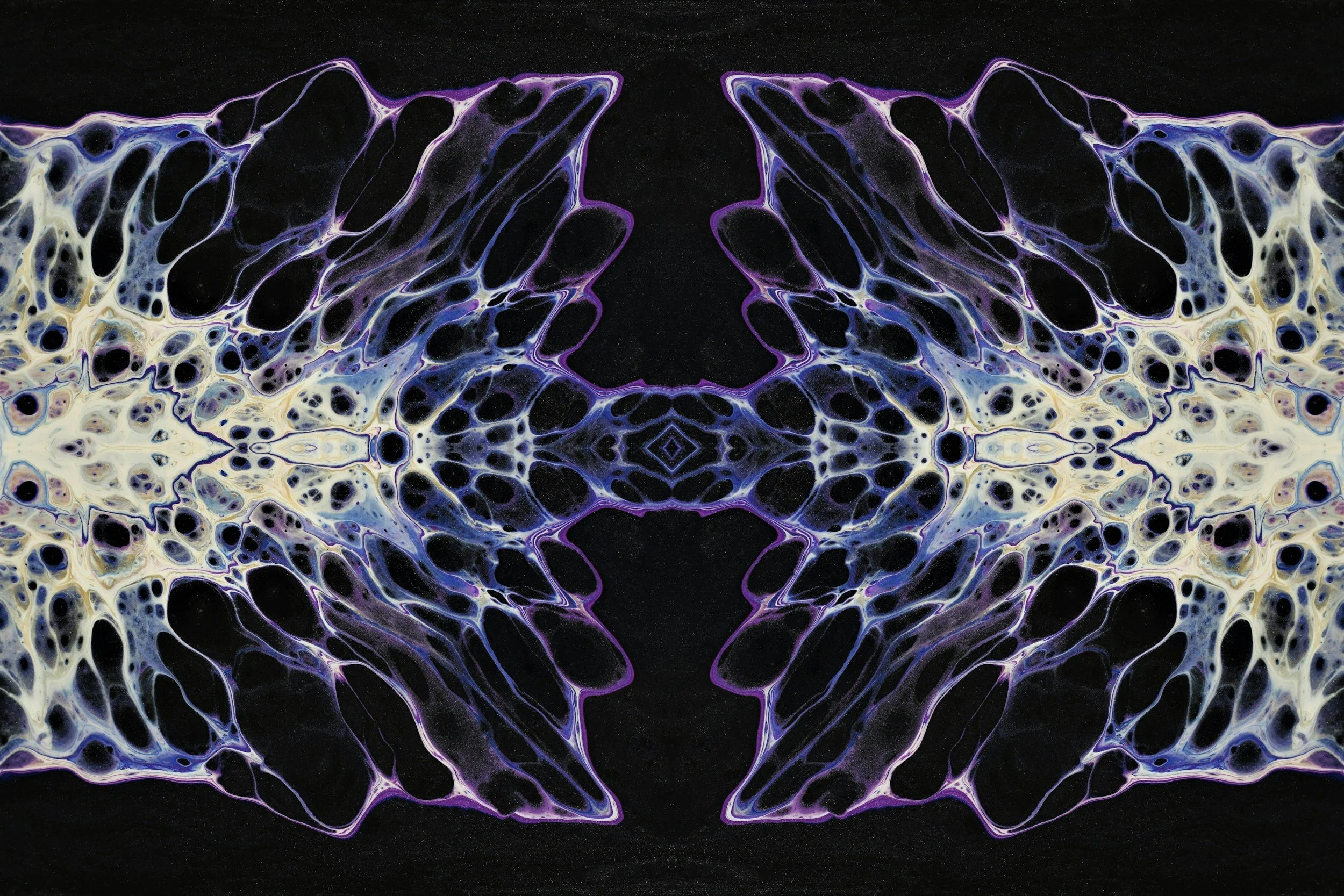
Cymatics: Visualizing frequencies and the patterns of sound
Sacred geometry and the golden ratio can be found in almost every living thing on earth—even in the things we can’t see, like music. That is, until you apply sound or specific frequencies to a Chladni plate, which vibrates and rearranges sand on its surface, depicting stunning unique patterns for every sound and frequency. I didn’t have a Chladni plate, so I set out to hack the mechanism using materials at home.
I had recently come across some videos of people using Chladni plates to visualize sound. A Chladni plate is a metal plate hooked up to a frequency generator. In order to visualize the effect, sand is added to the top of the plate. When a frequency is set on the device, like 440hz, the sand scatters and rearranges, making incredible patterns that differ at each frequency.
As both a designer who loves making patterns and a fierce music aficionado, this felt like a prime mashup for my own experimentation.
I researched some Chladni kits online, but they typically retail at $300+, so I decided to see if I could replicate some of the effects using items from my home—primarily my kitchen.
For this experiment, I used the following:
JBL Pill Speaker
Dutch oven
Aluminum roasting pan
Construction paper, assorted colors
Disposable pie crust tin & plastic cover
Leaves
Salt
Sand
Water
I tried many different configurations of these items, typically placing the speaker inside either the Dutch oven or the roasting pan, to use the metal as a conductor for sound, as Chladni plates do.
I tried several genres of music, with a range of use of instruments vs music kits. I found that with this setup, bass-heavy music yielded more interesting patterns and movement, though this wasn’t an absolute. Sometimes bassier music didn’t show up the way I wanted. I didn’t do a meticulous search for songs here (next time, I might categorize and observe BPM as well), but I pulled from a Spotify playlist featuring bass-heavy songs and from my own library of songs I could think of with heavy bass.
All videos seen here were filmed with my iPhone and saved to my Google Photos (would opt for DSLR & saving to a local device in the future to ward off the digital degradation).
Adele’s “Rolling in the Deep” showed intense ripples for almost the entire duration of the song. Watch closely around 0:55 when it fades and starts to curl in a different direction.
Experiment #1: Water and “Rolling In The Deep” by Adele
In this first video, I placed the speaker inside the Dutch oven, and put the plastic pie crust lid facing up on top of the Dutch oven. Then, I filled the lid with some tap water and let the song play.
The Beatles’ “Come Together” might not show much visible change at first, but when you scrub back and forth through the video, you see the morphing shape, seemingly being altered by the fringe edges.
Experiment #2: Salt and “Come Together” by The Beatles
For this attempt, I placed the speaker inside the Dutch oven, and put red construction paper on top of the oven. Then I topped the paper with a thin layer of salt.
Scrubbing ahead and back again shows a very interesting morphing shape, with different kinds of stryation. I personally love how using salt or sand shows most of the material sticking together in a pack, but the fringe pieces are always doing their own thing, dancing around. Almost as though the fringe is what’s shaping the bigger organism, guiding its trajectory.
… Makes sense to me, since the fringe of society is what has always driven its progress.
Experiment #2.5: Leaves and “Come Together” by The Beatles
Using the same song, I placed the speaker inside the Dutch oven, blue construction paper on top, and topped the paper with leaf fragments.
I wanted to use a material that could depict movement and sound with depth and shadow. While I think I’d use smaller fragments next time, this was a fun result.
Fleet Foxes “White Winter Hymnal” was one of the most suprising experiments, because I’d begun to expect a certain type of behavior from these materials. This one danced in an undeniable helix formation, like it was written in the cosmos.
Experiment #3: Salt and “White Winter Hymnal” by Fleet Foxes
For this attempt, I placed the speaker inside the Dutch oven, and black construction paper on top of the oven. Then I topped the paper with very few granules of salt vs. the larger mass from the previous experiment.
This is a quick, delightful version that shows the granules dancing in an upward spiral/helix formation. Because of course. IYKYK.
This showed me that more ≠ better when it comes to the material used.
Parting thoughts
This is not the last time I’ll play with this. Though this is less of a hacked Chladni plate and more a set of experiments to see sound waves on natural ephemera, I loved testing the mix of items and know there’s endless combinations I could play with in the future.
I think the water tests had the best result, so I’d likely aim to hone in on that subset.
Next time I’d aim for a better production—with my DSLR, tripod, lighting kits, and more.
When I get there, I’ll report back!