
EF / World Journeys
Closing the Loop: Designing a Full-Circle Travel Booking Experience in Mobile
CLIENT
EF / World Journeys
TEAM
EF / World Journeys Engineering Team
ROLE
Product Design
CATEGORY
Native Mobile App
E-Commerce
From 0 → 11% of bookings in one year—turning a post-booking app into a primary revenue channel.
This transformation began with a gap: despite 95% of travelers actively using the app, it functioned only as a post-booking tool, with no ability to browse or purchase trips.
I was the sole product designer responsible for reintroducing and scaling in-app commerce across three DTC travel brands—EF Go Ahead Tours, EF Ultimate Break, and EF Adventures—following a platform consolidation that had removed a previous, limited shopping experience.
The result was a full-funnel mobile experience that drove 3.7% of bookings within the first month for Go Ahead Tours, and ultimately grew to ~11% for Ultimate Break—catalyzing a broader shift from web-first to mobile-first strategy.
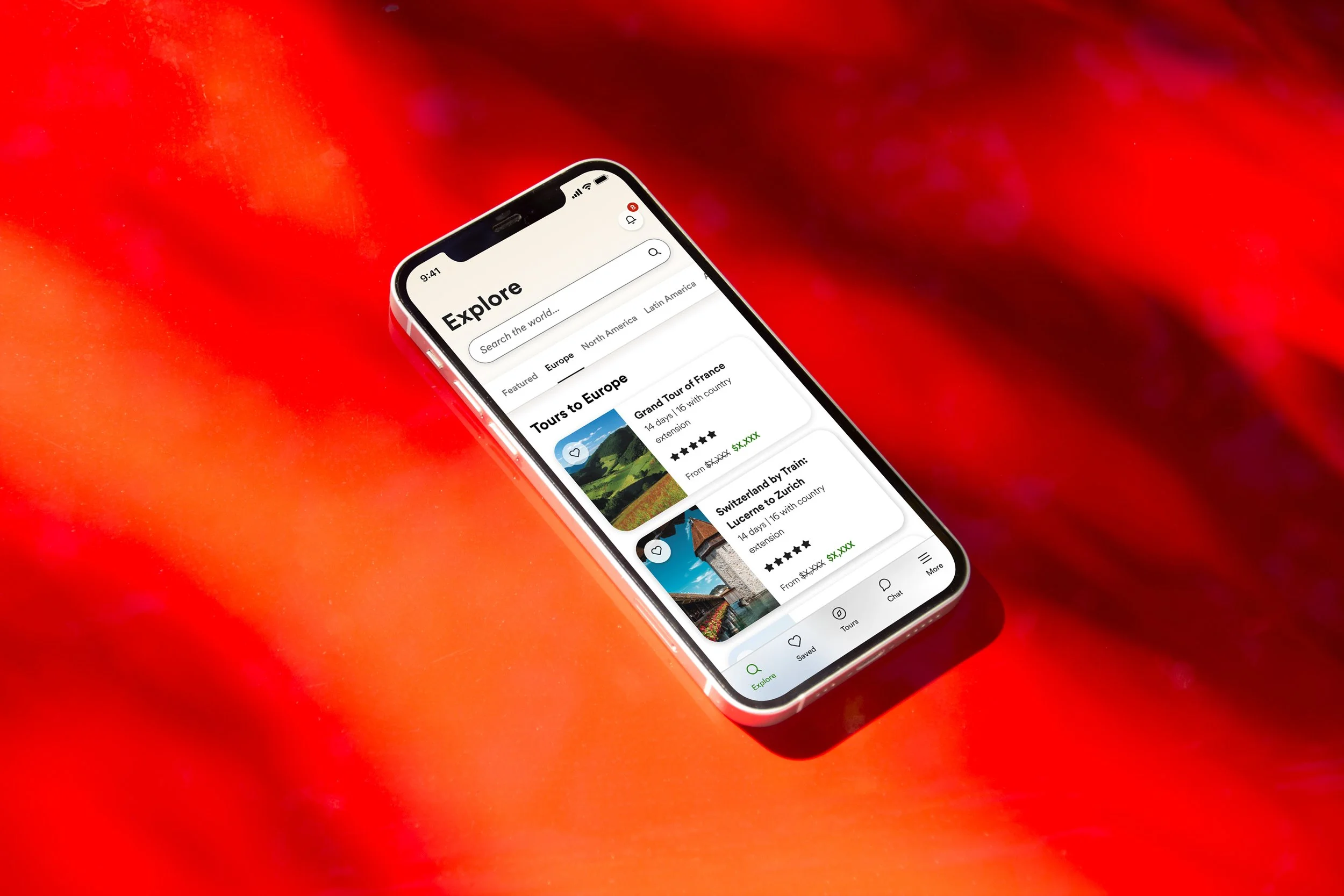
The opportunity
The app was widely used—but only after booking. There was no way to browse or purchase trips in-app.
This meant we were missing the most influential part of the journey: discovery, comparison, and return visits across sessions.
At the same time, stakeholders questioned whether mobile web alone was sufficient—and the platform had just been consolidated across three brands, adding complexity to any new experience.
Introducing shopping into the app wasn’t just a feature—it was an opportunity to reposition mobile as a significant part of the revenue funnel.
My role
As the sole designer on this initiative, I was responsible for shaping and shipping the end-to-end experience.
I partnered closely with product, analytics, and engineering to:
Audit and align mobile and web purchase flows
Define key systems (e.g., Saved Quotes, navigation structure)
Design browsing and re-engagement entry points
QA the full experience across all three brands
The relaunch was designed and shipped over ~4 months post-consolidation.
Key constraints
No native checkout → required seamless handoff to web
No traditional cart → needed a new model for saving in-progress trips
Shared multi-brand platform → limited customization
Inconsistent design systems → required alignment across mobile + web patterns
Rather than waiting for ideal conditions, I designed within these constraints to meet user expectations and move the business forward.
Reframing the app around discovery
The original app was structured for trip management—not exploration.
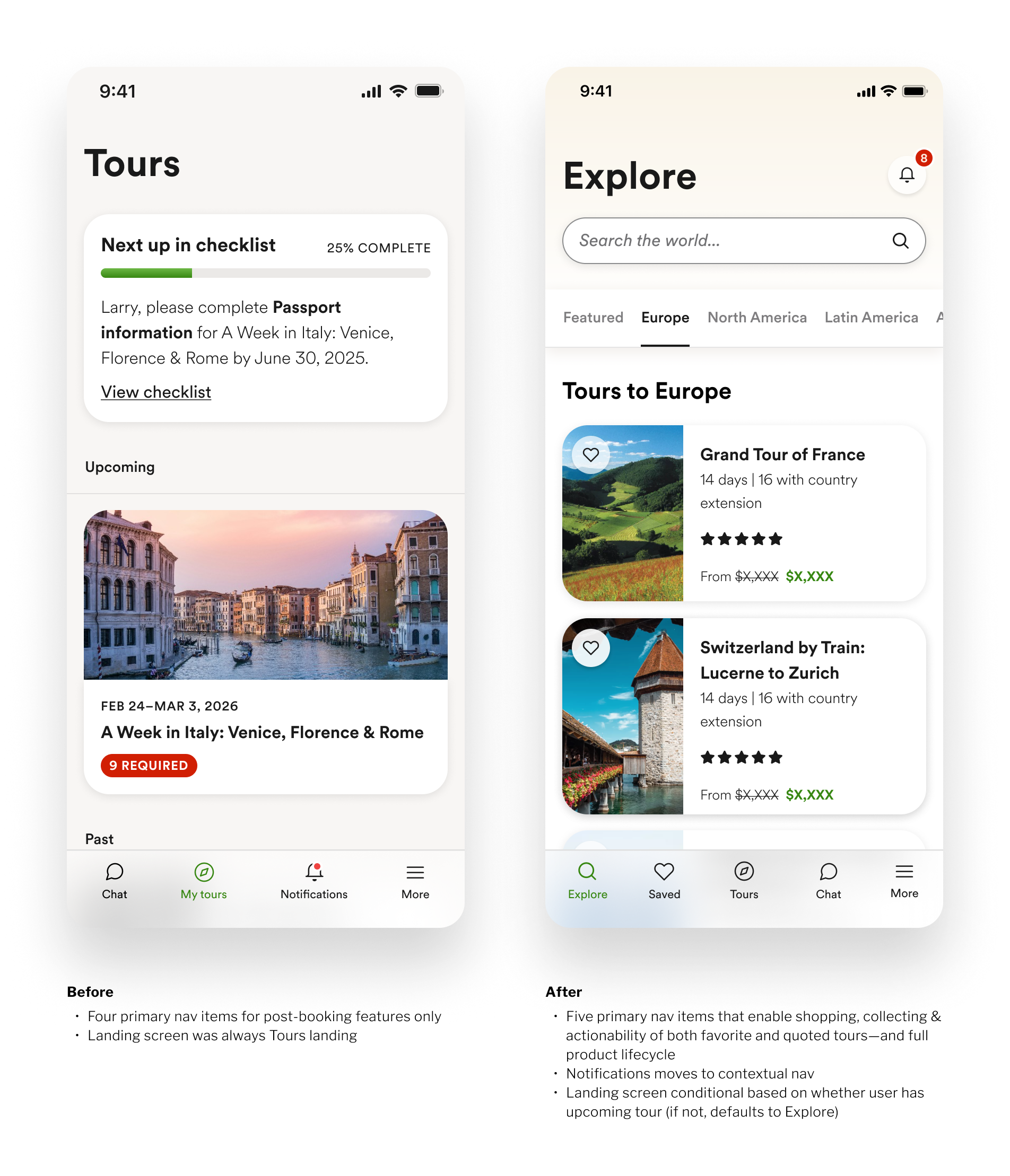
I redesigned the primary navigation to prioritize discovery and re-engagement:
Before
Chat | My tours | Notifications | More
After
Explore | Saved | Tours | Chat | More
Explore became the primary entry point for browsing
Saved unified wishlists and in-progress trips
Notifications were deprioritized to reduce noise
This shift aligned the app with how travelers actually plan: exploring, comparing, and returning over time.
Saved Quotes
Travel booking doesn’t fit a traditional cart model. Each trip includes interdependent variables—dates, flights, rooming, add-ons—that evolve over time.
I designed Saved Quotes as a progressive state system—capturing and persisting progress from a minimal set of inputs (date, travelers, flight preference) through to an almost-complete booking, without requiring a fixed endpoint.
Each time a user configures a tour and selects “Save and continue,” a Saved Quote is created—persisting that exact configuration for easy return.
This allowed users to:
Save and compare trips
Leave and return across sessions and devices
Resume exactly where they left off
Quotes were priced and locked for 48 hours, then stored as “Expired” in a for up to 30 days—balancing urgency with flexibility.
This system became a critical bridge between browsing and booking, supporting the real, non-linear way travelers make decisions.
Users previously used the app for post-booking actions only, but our work opened the funnel to leverage the app as a full-circle lifecycle engagement tool.
Seen here: User can browse tours, view tour information, and proceed to quote a tour in the app’s “tripbuilder”.
Each time a user configures a tour—selecting date, traveler count, and flight preferences—and chooses “Save and continue,” the system generates a Saved Quote as a persistent, revisit-ready state of that configuration.
The quote is then housed in the “Saved” nav section, with pricing locked for 48 hours. After that, the quote expires, but persists in user’s account for 30 days or until manual deletion (whichever is sooner).
(and of course there’s a bug in the radio component at time of screen recording :) )
Accessibility
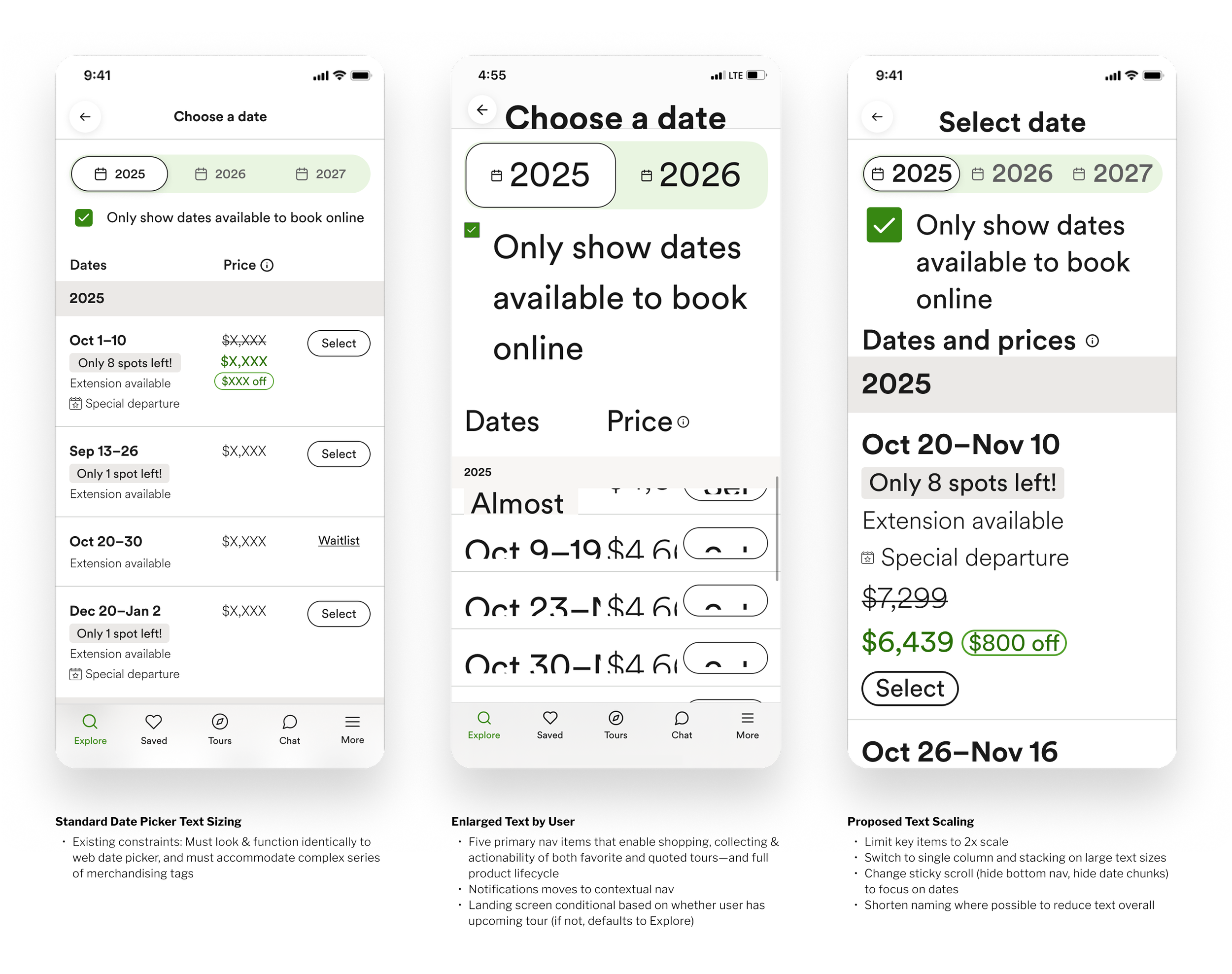
I also improved key decision points (e.g., date selection) to remain usable at large accessibility sizes, ensuring the experience worked for a broad age range.
The original layout broke under large accessibility text sizes—particularly impactful for Go Ahead’s large contingent of older users.
I redesigned it into a single-column, scalable layout, improving readability, information hierarchy, and reliability across accessibility settings.
This ensured the experience remained usable—and trustworthy—for all travelers.
Testing & validation
Due to aggressive timeline constraints, formal usability testing wasn’t feasible pre-launch.
To mitigate risk, I leveraged prior research, web flow parity, accessibility best practices, and extensive cross-brand QA to ensure consistency and reliability.
Results
3.7%
% of total bookings via mobile app purchases for Go Ahead one month after launch
11%
% of total bookings via mobile app purchases for Ultimate Break one year after launch
The relaunch successfully introduced full-funnel shopping into the mobile app—enabling travelers to browse, configure, and begin booking directly.
3.7% of bookings came from mobile within the first month (Go Ahead Tours)
~11% of bookings came from mobile within one year (Ultimate Break)
Beyond direct conversion, mobile browsing influenced bookings completed later via web and phone—establishing the app as a key discovery and engagement channel.
💡 What we learned
Mobile discovery drives measurable downstream conversion—even when purchases happen elsewhere
Supporting non-linear decision-making (via systems like Saved Quotes) is critical in complex purchases
Designing within platform constraints can still unlock meaningful business impact